
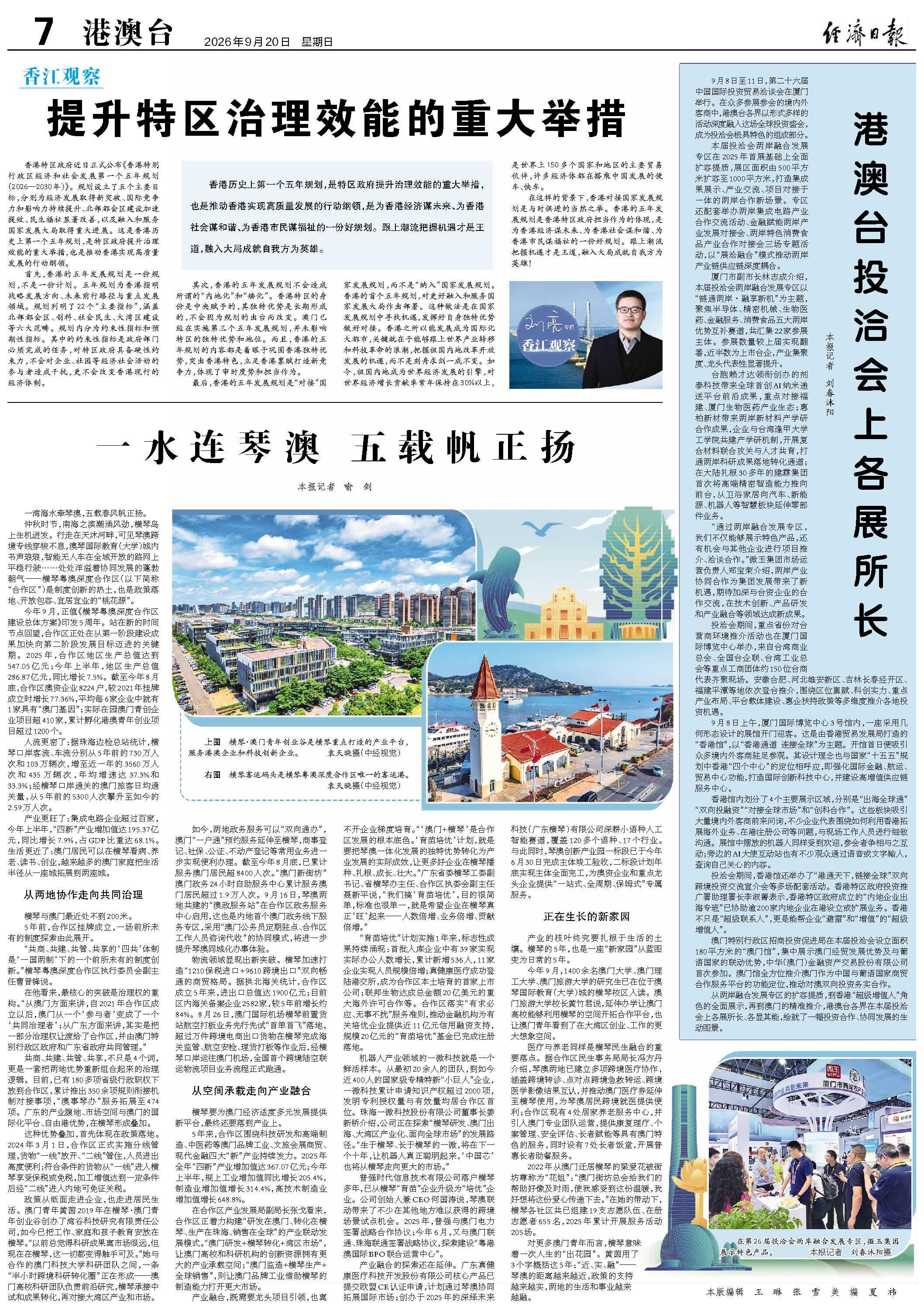
Connected by the sea, Hengqin and Macao sail forward after five years of progress.
In mid-autumn, Hengqin is alive with activity. Along the Tianmu River, cross-border bus services run continuously, students study in the Macao–Hengqin international education district, and autonomous vehicles travel smoothly across the open road network. The Guangdong–Macao In-Depth Cooperation Zone in Hengqin is a place of institutional innovation, practical policies, openness and inclusion, offering an attractive environment for living and working.
This September marks five years since the release of the zone's Master Plan. The zone is now moving from its first-phase achievements toward its second-phase objectives. Its GDP reached RMB 54.705 billion in 2025. In the first half of this year, GDP was RMB 28.687 billion, up 7.5% year on year. By the end of August, it had 8,224 Macao-invested enterprises, 77.36% more than at its inauguration in 2021—roughly one in every six enterprises had a Macao connection. More than 410 Macao youth entrepreneurship projects were operating in its parks, and over 1,200 Hong Kong and Macao youth projects had been incubated in total.
People are moving more frequently. According to the Zhuhai General Station of Exit and Entry Frontier Inspection, annual passenger and vehicle crossings at Hengqin Port rose from 7.3 million and 1.03 million five years ago to 35.6 million and 4.35 million in the latest year, with average annual growth of 37.3% and 33.3%. Average daily crossings by Macao travelers increased from 5,300 to 25,900.
Industries are becoming stronger. Hengqin has more than 100 integrated-circuit enterprises. In the first half of this year, the four emerging industries generated RMB 19.537 billion in added value, up 7.9% year on year and accounting for 68.1% of GDP. Daily life is becoming more connected too: Macao residents can access healthcare, retirement services, education and entrepreneurship in Hengqin, extending family life across both places.
From cooperation between two places to shared governance
At their closest point, Hengqin and Macao are less than 200 metres apart.
The zone's inauguration five years ago launched an unprecedented exploration of governance.
Cao Jinfeng, Deputy Director of the zone's Executive Committee, described joint consultation, construction, administration and benefit sharing as an unprecedented institutional innovation under one country, two systems.
In Cao's view, the central breakthrough is the restructuring of governing authority. Since 2021, Macao has moved from participant to co-governor, while Guangdong has transferred some governing powers to the zone, which is jointly administered by the Macao SAR Government and Guangdong Provincial Government.
These four principles form a governance approach that recombines the strengths of both places. More than 180 provincial administrative powers have been delegated to the zone, over 350 measures have been introduced to align rules and mechanisms, and 474 Macao-related services can now be handled in Hengqin. Guangdong's industrial base and market connect with Macao's international platform and free-port advantages.
This combination first becomes visible in policy implementation. On March 1, 2024, the zone introduced separate customs administration: the first line was opened and the second line controlled, with convenient movement of people. Eligible goods entering Hengqin through the first line receive bonded or duty-free treatment. After meeting processing and value-added requirements, they can enter the mainland through the second line without customs duties.
Policy benefits reach both businesses and households. Huang Yin, a young entrepreneur from Macao, founded Wangu Technology Research Co., Ltd. at the Hengqin–Macao Youth Entrepreneurship Valley in 2019. She has since based her work, family and children's education in Hengqin. Research once seemed far removed from the market, she said, but commercialization now feels within reach. Working with a Macau University of Science and Technology team, she is helping form a half-hour cross-border research-to-market circle: Macao researchers undertake frontier work, Hengqin supports pilot development and commercialization, and the results connect to Greater Bay Area industries and markets.
Government services can now be handled in both directions. Macao's One Account appointment services extend to Hengqin, and business registration, social security, notarization and property registration have become more convenient. By the end of August, these services had served Macao residents more than 8,400 times. The 24-hour Macao government self-service centre in Macao New Neighbourhood had provided over 19,000 services. On September 16, a jointly established Macao Government Service Station opened at the zone's government service centre—the first dedicated offline Macao government service area on the mainland. Macao civil servants attend regularly, while zone staff provide consultations and receive applications, improving the experience of handling affairs across the two places.
Logistics is also advancing. Hengqin is developing two-way trade using the 1210 bonded-import and 9610 cross-border export models. Gongbei Customs reported RMB 190 billion in imports and exports over the zone's first five years, with 2,582 customs-registered enterprises, approximately 84% more than five years earlier. On August 26, the Hengqin upstream cargo terminal for Macau International Airport completed its first pilot air-cargo pallet-building shipment and flight. More than 10,000 cross-border e-commerce export items underwent customs supervision, aviation security screening, sorting and pallet building in Hengqin before traveling through Hengqin Port to Macao's airport, completing China's first cross-border road–air logistics workflow.
From providing space to integrating industries
Hengqin's role as a new platform for Macao's economic diversification ultimately depends on industry.
For five years, the zone has developed four emerging industries: technology R&D and high-end manufacturing; Macao-branded industries such as traditional Chinese medicine; culture, tourism, conventions, exhibitions and commerce; and modern finance. Their added value reached RMB 36.707 billion in 2025. In the first half of this year, added value in industrial enterprises above the designated size rose 205.4% year on year, manufacturing rose 314.4%, and high-tech manufacturing rose 648.8%.
Zhang Ge, Deputy Director of the zone's Economic Development Bureau, said it is building a coordinated model of research in Macao, commercialization in Hengqin, production in Zhuhai and global sales. Macao research, Hengqin commercialization and the Greater Bay Area market give universities and research institutions more room to realize their innovations. Macao supervision, Hengqin production and global sales enable Macao brands to reach larger markets through Hengqin's manufacturing capabilities.
Integration needs both major projects and staged enterprise support. Nie Xinping, Deputy Secretary of the provincial Hengqin working committee, Director of the provincial Hengqin office and Deputy Director of the zone's Executive Committee, said Macao plus Hengqin is the zone's defining foundation. Its enterprise cultivation program aims to turn the advantages of integration into results, helping promising businesses take root and grow. Its straightforward objective is for companies to thrive in Hengqin by multiplying their workforce, business and contribution.
One year into the program, 39 first-cohort enterprises had increased their on-site workforce by a combined 536 people, and 11 had doubled their staffing. Zhen Health Medical became the zone's first locally cultivated company to list in Hong Kong, while United Biotechnology reached a major overseas licensing agreement worth US$2 billion. Following a service principle of responding when needed without unnecessary disruption, the zone helped financial institutions provide nearly RMB 1.1 billion in credit financing to relevant growth-support enterprises. A RMB 2 billion enterprise cultivation fund has also been registered and established.
AMicro offers a vivid example in robotics. From an initial team of just over 20, it has grown into a national specialized and innovative Little Giant with nearly 400 staff. It has filed more than 2,000 intellectual property applications and ranks first in the zone for both granted and valid invention patents. Chairwoman Jiang Xinqiao said it is exploring a model of research in Hengqin, international expansion through Macao, industrialization in the Greater Bay Area and sales worldwide. Born and raised in Hengqin, AMicro aims to make robots truly intelligent over the next decade and take Chinese-developed chips into larger markets.
Puqiang Times Information Technology Co., Ltd., established in Hengqin for several years, has advanced from a seedling enterprise to a growth-support enterprise. Founder and CEO He Guotao said Hengqin–Macao collaboration provides cross-border pilot opportunities difficult to find elsewhere. In 2025, Puqiang signed a strategic agreement with Macao's electricity company. This June, it signed another with China Unicom Macao and China Unicom Zhuhai to explore a Guangdong–Hong Kong–Macao international BPO joint operations centre.
Integration continues to expand. Guangdong Zhen Health Medical Technology Development Co., Ltd. has applied for EU CE certification for its core product and plans to expand internationally through Hengqin–Macao cooperation. Founded in 2025, Shenyi Future Technology (Guangdong Hengqin) Co., Ltd. focuses on AI for less widely used languages, covering more than 120 languages and 17 industries. Meanwhile, the first construction section of the Hengqin–Macao innovation industrial park passed structural completion acceptance on June 30. The second is scheduled to complete its main structures by year-end, with dedicated one-stop, full-lifecycle services for Macao-invested and major leading enterprises.
A new home taking shape
Industries ultimately need roots in everyday life. Hengqin's past five years have also turned the vision of a new home into daily reality.
This September, more than 1,400 postgraduate students from the University of Macau, Macao Polytechnic University and Macao University of Tourism began studying at Hengqin campuses in the Macao–Hengqin international education district. Macao University of Tourism Rector Fanny Vong said expansion into Hengqin gives Macao universities space for new cooperation platforms and helps young people envision wider opportunities to work and start businesses in the Greater Bay Area.
Healthcare and eldercare are also central to integration. Feng Fangdan, Director of the zone's Livelihood Affairs Bureau, said the two places have established cross-border referrals, point-to-point emergency transfers and mutual recognition of medical imaging results, while extending the use of Macao healthcare vouchers to Hengqin. The zone has four home-based eldercare service centres operated with professional Macao teams, offering rehabilitation, case management, safety assessments and services that support older people's independence. Seven senior dining halls also provide inclusive meal services.
Leong Oi Fa, known locally as Sister Fa, moved from Macao to Hengqin in 2022. She described the support from Macao's neighbourhood association as timely and warm, inspiring her to pass that care on to others. With her encouragement, Hengqin communities have formed 19 volunteer teams with 655 registered volunteers, organizing 205 service activities in 2025.
For many young people from Macao, Hengqin represents a chance to step into a wider world. Huang Yin summarized the five years as closer, practical and integrated: the two places feel nearer, policy support is more tangible, and work and life are increasingly connected.