
On September 17, 2021, the administrative bodies of the Guangdong–Macao In-Depth Cooperation Zone in Hengqin were inaugurated, beginning an unprecedented model of joint consultation, construction, administration and benefit sharing.
Hengqin Island in Zhuhai, Guangdong, lies just across the water from Macao, less than 200 metres away at the nearest point. Lotus Bridge spans the Shizimen waterway, connecting daily life and aspirations on both sides. Over five years, easier travel, more compatible systems and greater room for development have transformed geographic proximity into deeper integration. More than 8,200 Macao-invested enterprises now operate in Hengqin, giving roughly one in six local companies a Macao connection. About 100,000 passenger crossings take place through Hengqin Port each day. These figures reflect accelerating integration and a practical example of one country, two systems.
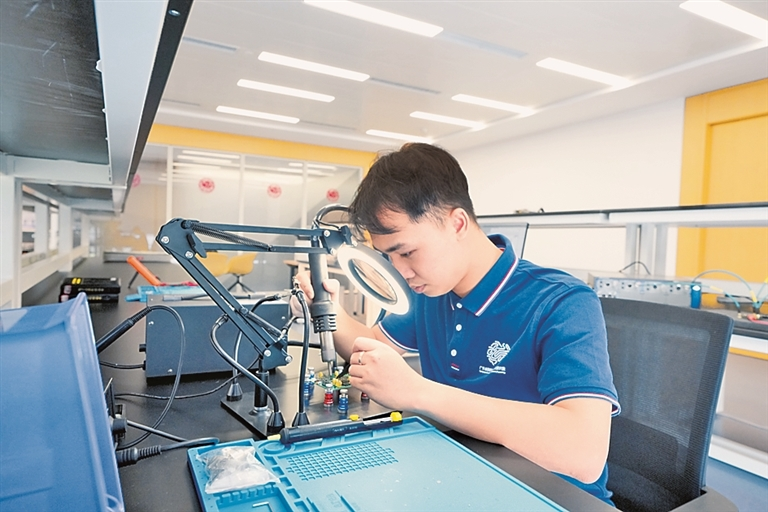
Researchers test circuit-board chips in a laboratory in the Cooperation Zone. Photo courtesy of the Guangdong–Macao In-Depth Cooperation Zone in Hengqin.
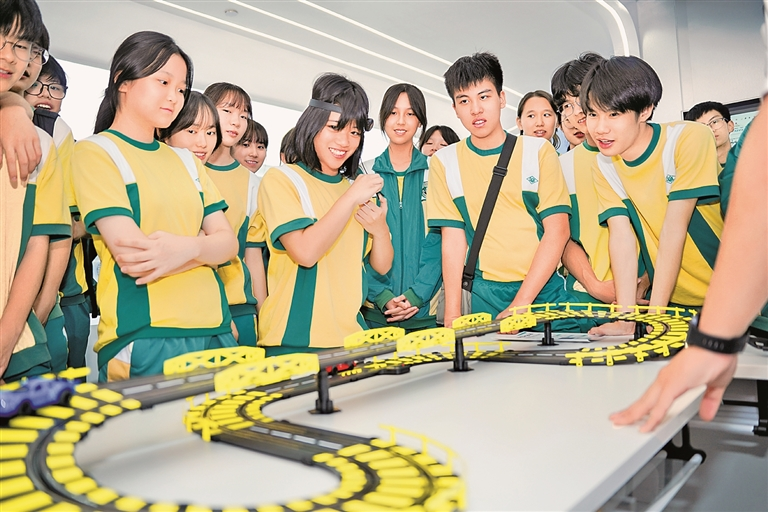
Macao secondary school students experience Hengqin's innovation activities. Photo courtesy of the Guangdong–Macao In-Depth Cooperation Zone in Hengqin.
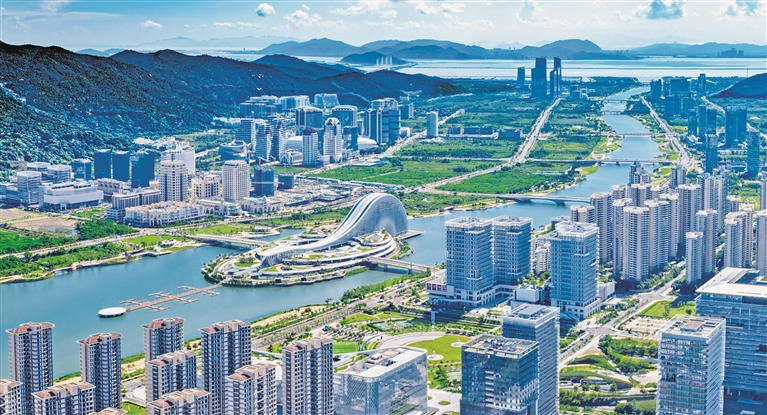
An aerial view of the Cooperation Zone. Photo courtesy of the Guangdong–Macao In-Depth Cooperation Zone in Hengqin.
Macao's strengths become part of Hengqin's industrial ecosystem
At AMicro's showroom at 88 Zhishui Road on Hengqin Island, a wall of dedicated robotics chips glints under the lights. From the brains of cleaning robots to the control centres of commercial, industrial and embodied-intelligence robots, these precision technologies tell a story of research–industry collaboration between Guangdong and Macao.
Chairwoman Jiang Xinqiao recalled that in 2019, the company urgently needed leading research capabilities to tackle core technologies and approached the University of Macau, known for its microelectronics research. The first meeting immediately revealed a strong fit: the company brought commercial applications, engineering experience and deployment capabilities, while the university offered frontier research, leading researchers and laboratory resources. Separated only by a waterway, they could complement one another.
The partnership began with a joint laboratory and expanded into joint postdoctoral training, patent commercialization and national key R&D projects. Over seven years, this connection between original research in Macao and industrial deployment in Hengqin has generated more than RMB 500 million in economic benefits.
Hengqin's location and stable policy framework also create opportunities for young entrepreneurs from Macao.
At the Hengqin showroom of Shengwu Technology Co., Ltd., discarded tea leaves, traditional Chinese medicine residues and distillers' grains become sustainable materials for cups, travel cutlery, construction panels and electronic-device casings. Founded by young people from Macao, the materials start-up grew rapidly after moving to Hengqin in 2020. It partnered with several well-known mainland tea brands, built a smart factory in Dongguan, established a sales centre in Shenzhen and expanded international business through Hong Kong.
Founder Xiao Qidong said developing in Hengqin felt like finding a new comfort zone for someone from Macao. Its location makes it easier to connect with Greater Bay Area supply chains, while policies supporting Macao businesses and technology start-ups allow teams to focus on R&D and market development. More than 410 Macao youth entrepreneurship projects now operate in the zone's parks, giving young entrepreneurs like Xiao greater confidence to move forward.
Longstanding Macao brands are finding new paths too. Aobang Pharmaceutical's Macao-brand Qianli Zhuifeng Oil became the first medicine manufactured in Hengqin under a contract-manufacturing permit issued by Macao's Pharmaceutical Administration Bureau. The model of Macao supervision and Hengqin production helps traditional Chinese medicine brands overcome land and capacity constraints.
Across traditional and innovative sectors, these partnerships are making Macao's economic diversification more tangible. By the end of August, the zone had more than 8,200 Macao-invested enterprises, over 76% more than at its inauguration in 2021. More than 5,700 operated in the four emerging industries—technology R&D and high-end manufacturing, Macao-branded industries including traditional Chinese medicine, culture, tourism, conventions, exhibitions and commerce, and modern finance—an increase of over 80% in five years.
Aligned rules make two-city living feel like one
Hengqin Port is one of the Greater Bay Area's busiest cross-border routes. At midday, Macao university student He Yuanying walks across from Macao and reaches a Hengqin street within minutes. During five years of study, she has found travel between the two places increasingly convenient.
Six years ago, a cooperative inspection and single-release model was introduced in Hengqin Port's passenger area, reducing average clearance time to 20 seconds. Last November, 64 smart cooperative channels began operating, bringing facial recognition to cross-border travel. A mainland resident surnamed Liu who works in Macao said she can now pass through a gate in about five seconds. This May, vehicle lanes also adopted facial-recognition technology, allowing drivers to complete both jurisdictions' checks using fingerprints and facial recognition without presenting physical documents.
Beyond travel, broader rule alignment is advancing. The Greater Bay Area's one country, two systems and three legal jurisdictions previously prevented Hong Kong and Macao lawyers from practicing directly on the mainland. The first Greater Bay Area legal professional examination was held in 2021. After passing and obtaining the relevant practice certificate, Hong Kong and Macao lawyers can handle certain civil and commercial matters governed by mainland law in the nine mainland Greater Bay Area cities, connecting the three legal-service systems.
Macao lawyer Huang Jingxi was among the first to qualify in 2021. He now travels from his Macao home to a joint Guangdong–Hong Kong–Macao law firm in Hengqin, with a commute of just half an hour.
By the end of August, 507 lawyers practiced in the zone, including 51 from Hong Kong and Macao, of whom 37 held Greater Bay Area qualifications. Six joint law firms were operating. Fifty-eight Hong Kong and Macao tax professionals held cross-border qualifications and practiced in the zone. The first joint tax advisory firm established by Hengqin and Macao professionals also opened, advancing the alignment of professional-service rules and mechanisms.
Tax bills show further benefits. Hengqin's two 15% incentives reduce burdens on eligible companies and talent: qualifying enterprises pay corporate income tax at 15%, while eligible high-end and urgently needed professionals are exempt from the portion of their tax burden above 15%. Macao residents are also exempt from the portion of personal income tax exceeding the Macao tax burden. Over five years, the Macao-resident policy has benefited 2,200 instances of taxpayers and reduced taxes by more than RMB 120 million.
From border clearance and professional practice to taxation and public services, the zone has introduced 350 rule-alignment measures covering trade, business and livelihoods. More than 470 Macao-related services can be handled in Hengqin. A familiar phrase captures the convenience: eat in Macao, then take the leftovers home to Hengqin. Life across the two places increasingly feels like life in one city.
Integrated public services support a better everyday life
In September, beside the Tianmu River, new first-year secondary students line up for the opening ceremony at Hou Kong School Affiliated to Hengqin, their faces full of anticipation.
Located in Macao New Neighbourhood, it is the mainland's first school for children of Macao residents. Its secondary section welcomed its first students this autumn, with plans for a continuous pathway from kindergarten through senior secondary education. Executive Principal Chan Hong said the school would continue responding to Macao families' educational needs and deepen the sharing of educational resources across Hengqin and Macao.
Nearby, the first phase of the Macao–Hengqin international education district hosted another significant ceremony. The University of Macau, Macao Polytechnic University and Macao University of Tourism held their first joint opening ceremony, welcoming more than 1,400 postgraduate students in fields including AI, microelectronics, big data and the Internet of Things, and cultural and creative industry management.
University of Macau doctoral student Yang Shihao said teaching resources connect smoothly with the main campus, making the benefits of shared learning and research resources clear. Microelectronics postgraduate Chen Yifan praised the new campus facilities, including its canteen, supermarket and fitness centre, which support a productive daily routine.
From classrooms to neighbourhoods, Macao New Neighbourhood is becoming a new home for more residents. As the mainland's first integrated livelihood development built for Macao residents, it already accommodates more than 4,000 of them. Cantonese is heard along the streets, small mobile payments in patacas are accepted in restaurants and shops, Macao-plated cars are common, and free shuttle buses run between the two places several times a day.
Resident Tong Kam Chan brought Chengpin Coffee, which she had operated in Macao for 20 years, into the neighbourhood. Registration to opening took just three working days. She praised the air quality and the school, health station and senior service centre built to Macao standards, describing a seamless connection with life in Macao. She has since opened a hotpot restaurant as well, and her family has settled into an active new life.
Eldercare is also available. The zone has established four home-based eldercare service centres using Macao's aging-in-place approach. Over five years, eldercare facilities have provided 828,000 services, including more than 69,000 for older Macao residents.
Connected education, a sense of home and reliable eldercare are turning Macao residents' hopes for a better life into everyday reality in Hengqin.