
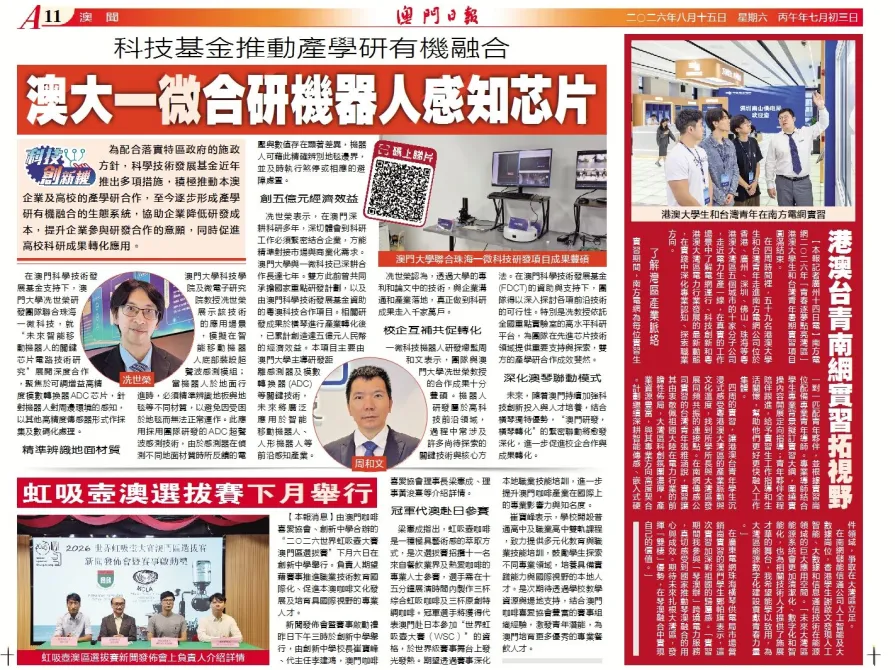
Macao Daily News recently published an A11 feature on the University of Macau and AMicro’s joint robotics perception chip research. As a leading chip-level full-stack intelligent robotics platform in China, AMicro continues to pursue innovation and Hengqin–Macao integration in support of Macao’s economic diversification.
The report noted that the Macao Science and Technology Development Fund has introduced measures supporting collaboration between local companies and universities. These efforts help reduce R&D costs, encourage partnerships and commercialize university research, creating an integrated innovation ecosystem. AMicro’s collaboration with the University of Macau is an example of this approach.
Seven years of collaboration deliver results
AMicro and the University of Macau have worked closely for seven years, progressing from laboratory chip-circuit research to commercialization in Hengqin through a “Macao R&D, Hengqin commercialization” model.
The partners have jointly undertaken national key R&D projects and Guangdong–Macao technology cooperation projects supported by the Macao Science and Technology Development Fund. Commercialization in Hengqin has generated economic benefits exceeding several hundred million renminbi.
ADC perception chips help robots sense the world
Supported by the fund, Professor Sin Sai Weng’s team at the University of Macau and AMicro are researching key chip-circuit technologies for future intelligent mobile robots. The project focuses on high-precision analog-to-digital converters (ADCs) with adjustable gain, using precise sensing and digitization to improve robotic perception.
Professor Sin described an application using an ultrasonic sensing module beneath a mobile robot to distinguish flooring from carpet and avoid becoming trapped. Different materials produce distinct voltage signals. The team’s ADC-based ultrasonic sensing technology detects carpet boundaries and enables timely braking or obstacle avoidance, helping robots perceive differences in the surface below them.

Complementary strengths support commercialization
Professor Sin said years of research in Macao had demonstrated the importance of close industry collaboration in meeting market and commercialization needs. Connecting university patents and published research with companies helps bring research results into everyday use.
AMicro’s robotics R&D lead described the collaboration as highly productive. Robotics research involves emerging technologies and methods that require further exploration. Support from the Science and Technology Development Fund (FDCT) enables assessment of their feasibility. Professor Sin’s high-level national key laboratory platform has provided important support for advanced chip research, contributing to strong collaboration results.
Deepening Hengqin–Macao innovation links
The University of Macau leads work on distance sensors, ADCs and other technologies, while AMicro focuses on turning university research into commercial chip products. From technical collaboration to products, and from Hengqin to the national market, the company demonstrates the value of integrated research and industry.
As Macao increases investment in innovation and talent, Hengqin’s complementary strengths will deepen the “Macao R&D, Hengqin commercialization” model. AMicro will continue working with the University of Macau and other leading institutions to accelerate technology transfer.
Bringing robots to every industry
Driven by innovation and research–industry collaboration, AMicro will continue its work in Hengqin and Macao, partner with leading universities, and accelerate the transformation of frontier research into practical capabilities, bringing robots to every industry, supporting diverse aspects of daily life and improving people's lives.